Offices · Restaurants · Retail
Commercial AC & Chiller Repair
VRV/VRF systems, chillers, and fan coil units — certified technicians who understand minimizing downtime matters as much as the fix itself.
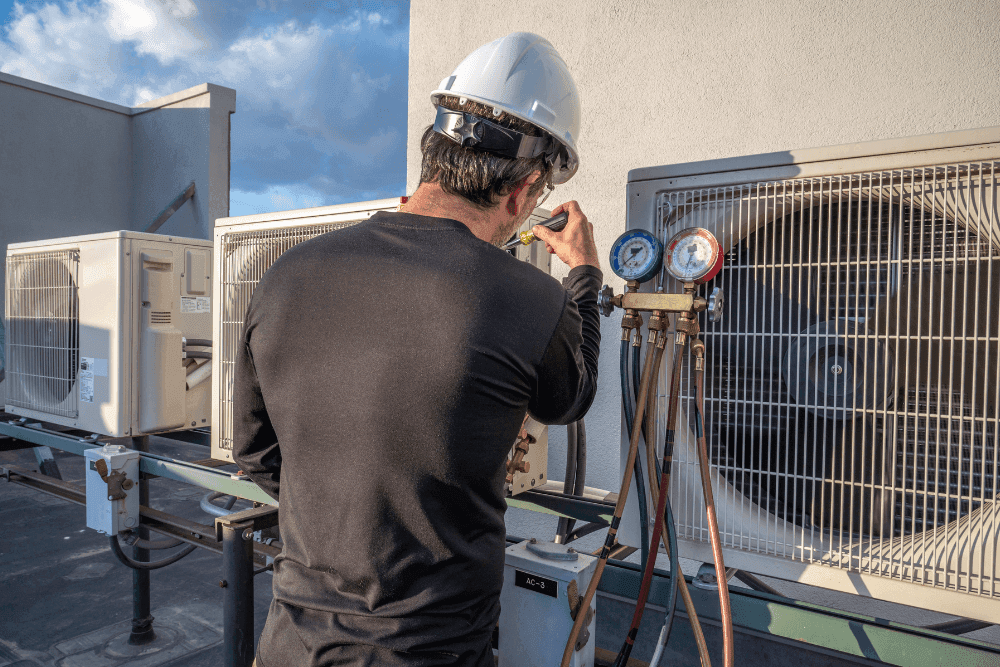
Systems We Service
VRV / VRF Systems
Variable refrigerant systems common in newer office buildings and larger retail spaces — multiple indoor units run off a shared outdoor condensing unit, meaning a single fault can affect several zones at once. Diagnosis on these systems always starts with mapping exactly which zones are affected, since that tells us whether the fault is at the shared outdoor unit or isolated to a specific indoor unit's expansion valve.
Chillers
Central cooling for larger commercial and mixed-use buildings, working by cooling water rather than refrigerant directly. Chiller faults are rarely a quick fix, but rarely need to be — most issues are diagnosable and repairable without a full system replacement, and a chiller fault affects the whole building's cooling capacity, making it a higher-priority diagnosis than a single-zone complaint.
Fan Coil Units (FCU)
The indoor half of a chilled-water system, common in offices and hotels — each FCU receives chilled water from the central chiller and blows conditioned air into its specific zone. FCU faults are usually isolated to a single zone, making diagnosis more contained than a VRV/VRF or chiller fault, since the rest of the building's system keeps running normally.
Package Units
Common on restaurant and retail rooftops — self-contained systems combining compressor, coil, and fan in one outdoor unit, straightforward to access for service compared to split systems. Because everything's in one unit, diagnosis is more similar to residential AC troubleshooting than the more distributed VRV/VRF or chiller architecture.
Cassette AC
Ceiling-mounted units common in offices, restaurants, and retail spaces where a wall-mounted split isn't practical. Filter and coil access is from below via a removable panel, and cleaning follows a similar process to a split unit — just working from ceiling height rather than a wall.
How Commercial Cooling Systems Actually Differ
Commercial cooling differs from residential AC in one fundamental way: scale changes the failure mode. A single split unit failing affects one room; a VRV/VRF outdoor unit failing can take out cooling across an entire floor or multiple zones simultaneously, because several indoor units share one refrigerant circuit and one compressor. Understanding which system type a building actually has — VRV/VRF, chiller-and-FCU, or self-contained package units — is the first step in any commercial diagnosis, since the failure patterns and repair approach differ meaningfully between them.
VRV (Variable Refrigerant Volume) and VRF (Variable Refrigerant Flow) systems are functionally similar — both let a single outdoor condensing unit serve multiple indoor units, each independently controlled, by varying the refrigerant flow to match each zone's actual demand rather than running all zones at a fixed rate. This is more efficient than older systems, but it also means the refrigerant piping network is more complex, with more potential leak points spread across a building than a single split system would have.
Chillers work on a different principle: rather than circulating refrigerant directly to each room, a chiller cools water (or a water-glycol mix) centrally, and that chilled water is pumped to fan coil units (FCUs) throughout the building, where it absorbs heat from room air. This means a chiller fault and an FCU fault look similar from inside a room — reduced or no cooling — but are entirely different repairs: a chiller fault affects the whole building's cooling capacity, while an FCU fault is usually isolated to whichever zone that unit serves.
Air-cooled chillers reject heat directly to outside air, similar in principle to a large-scale AC condenser, and are more common in Abu Dhabi given lower water requirements. Water-cooled chillers use a cooling tower and are more efficient at scale but need more infrastructure and maintenance — mostly seen in larger commercial and mixed-use developments rather than standalone restaurants or offices.
Common Commercial Faults, and Why They're Different From Residential
Zone imbalance on VRV/VRF systems
One zone running noticeably warmer or colder than others on the same outdoor unit often points to a refrigerant distribution issue or a faulty expansion valve at that specific indoor unit, rather than a fault with the outdoor unit itself.
Chiller compressor short-cycling
Similar underlying cause to residential short-cycling — often a refrigerant charge or pressure switch issue — but at chiller scale this affects building-wide cooling capacity rather than a single room, making it a higher-priority diagnosis.
Cooling tower scale buildup (water-cooled chillers)
Mineral scale accumulating in the cooling tower reduces heat rejection efficiency over time — a maintenance item specific to water-cooled systems that air-cooled chillers don't have to account for.
FCU valve and actuator faults
The valve controlling chilled water flow into an individual FCU can stick or fail, cutting cooling to that specific zone while the rest of the building's chilled-water system continues operating normally — a contained, single-zone repair rather than a building-wide issue.
BMS integration and sensor faults
Buildings with a Building Management System monitoring and controlling HVAC centrally can develop faults in the sensors or communication links feeding that system — sometimes presenting as a comfort complaint (wrong temperature, system not responding to schedule) that traces back to a sensor or BMS fault rather than the cooling equipment itself.
Refrigerant leak detection across larger networks
A VRV/VRF system's more extensive piping network means a leak can develop anywhere along a longer run than a residential split system has — locating it takes more systematic leak detection across the network rather than checking a single, short refrigerant line.
How We Diagnose a Commercial System Fault
System identification and zone mapping
Before touching anything, we confirm exactly which system type is installed and which zones or indoor units are affected — critical for VRV/VRF and chiller systems where the fault's actual scope isn't always obvious from a single room's complaint.
Isolate where possible
For a fault affecting one zone on a multi-zone system, we work to isolate that zone so the rest of the building keeps operating normally during diagnosis, rather than treating the whole system as offline.
Component-level diagnosis
Refrigerant pressure, electrical, and control signals are tested at the specific component level indicated by the symptom — an expansion valve, a specific FCU actuator, or the outdoor unit's compressor circuit, depending on what the zone mapping pointed to.
Fixed price and scheduling that respects operating hours
You get an exact price before work starts, and for anything not a genuine emergency, we schedule around your operating hours where possible rather than assuming daytime access is always convenient.
Minimizing Downtime Is Part of the Job, Not an Afterthought
For a residential call, downtime is an inconvenience. For a commercial property, it's lost revenue, food safety risk, or an uncomfortable customer or employee experience during business hours — which changes how we approach every stage of the job, not just the repair itself.
On multi-zone systems, isolating the affected zone rather than shutting down the whole system is the default approach wherever the fault allows it. On single-system properties where isolation isn't possible, we schedule around your operating hours when the fault isn't a genuine emergency, rather than assuming a daytime slot is always convenient for a business that's open during the day.
Parts availability matters here too — for common commercial components, we carry stock rather than defaulting to an order-in-and-wait approach that extends downtime unnecessarily for a fault that could have been resolved same-day.
Restaurants and Kitchens Specifically
A cooling failure in a restaurant carries a food safety dimension a comfort-cooling complaint elsewhere doesn't — walk-in coolers and cold storage losing temperature is a genuine, time-sensitive risk, not just a comfort issue, and we prioritize scheduling accordingly rather than queuing it behind routine requests.
Kitchen environments also accelerate wear on cooling equipment beyond what a typical office sees — grease particulate in the air fouls coils faster than ordinary dust, and heat load from cooking equipment puts extra demand on whatever system is cooling the dining area. Both are worth factoring into a more frequent maintenance schedule than a comparable office space would need.
Commercial Maintenance Contracts
The economics of scheduled maintenance are even stronger at commercial scale than residential. A VRV/VRF or chiller fault caught during a scheduled visit is a contained, planned repair. The same fault discovered as an unplanned outage during business hours costs more in lost revenue and reputational impact than the repair itself, especially for a restaurant or retail space where cooling failure is immediately visible to customers.
Commercial contracts are structured around your specific system — zone count for VRV/VRF, chiller capacity and cooling tower presence for chiller systems, FCU count for chilled-water buildings — rather than a flat per-unit rate that doesn't reflect actual system complexity.
Frequency also scales with usage and risk: a restaurant kitchen or a server room needing constant, reliable cooling typically warrants more frequent checks than a standard office space with predictable, lower-stakes usage patterns.
Office Buildings and Multi-Tenant Properties
Multi-tenant office buildings add a coordination layer beyond the technical diagnosis — a VRV/VRF fault affecting one tenant's zone needs to be isolated without disrupting neighboring tenants on the same shared outdoor unit, and scheduling often needs to account for multiple stakeholders (building management, individual tenants, sometimes a facilities management company) rather than a single decision-maker.
We coordinate directly with whichever party manages the relationship — building management for common infrastructure, or an individual tenant for something isolated to their leased space — and can work with existing facilities management processes rather than requiring a change to how your building already operates.
Retail Spaces
Retail cooling has its own pressures — customer comfort directly affects how long shoppers stay, and a store running warm during a UAE summer sees measurable impact on foot traffic and dwell time, not just complaints. That makes response speed genuinely commercially meaningful for retail in a way it isn't for, say, a back-office administrative space.
Retail units are also frequently part of a larger mall or retail development's shared infrastructure, meaning diagnosis sometimes needs to distinguish between a fault in your specific unit's system versus the building's shared supply — something worth clarifying with your landlord or facilities team before a technician visit, since it affects who's responsible for the fix.
Certified Technicians for Commercial Refrigerant Work
Commercial systems generally carry larger refrigerant charges than residential units, which makes correct handling more consequential — a leak or improper handling on a chiller or large VRV/VRF system isn't just a repeat-fault risk the way it would be on a small split unit, it's a genuine environmental and safety consideration given the volumes involved.
Our technicians working on commercial systems carry the same certification standard as our residential AC work, adjusted for the additional scale and complexity commercial refrigerant handling involves — not a lighter-touch approach just because the client is a business rather than a homeowner.
Access and Scheduling Logistics
Commercial properties often need site access coordinated through building security, a facilities team, or specific access hours — none of which a residential visit typically involves. We handle this coordination as part of scheduling rather than leaving it to figure out once a technician is already trying to get in the door.
For non-emergency work, after-hours or early-morning scheduling is available specifically to avoid disrupting business operations — worth requesting explicitly if your property's peak hours make daytime access genuinely disruptive rather than merely inconvenient.
Server Rooms and Critical Cooling
Some commercial spaces run cooling that's mission-critical rather than just comfort-related — a server room or equipment room where a cooling failure risks equipment damage, not just an uncomfortable afternoon for staff. These spaces warrant a different response standard: faster emergency response, more frequent scheduled checks, and often redundant cooling capacity built in specifically so a single unit failure doesn't mean total loss of cooling.
If your commercial property has a space like this, it's worth flagging explicitly when setting up a maintenance contract or booking emergency service — the priority and response expectations are genuinely different from a standard comfort-cooling complaint elsewhere in the same building.
Also Covered
For general appliance needs at your commercial property, see our other commercial services.
Commercial AC & Chiller Pricing
Commercial systems price by tonnage, system type, and access — a single-zone split serving a small office and a multi-zone VRV system across a retail floor are different jobs. Every repair gets a fixed price confirmed on-site before work starts.
Call-out & diagnosis
Varies by system type and tonnage; covers the first hour on-site
AED 200 – 480
Package / split commercial unit repair
Capacitors, fan motors, boards, minor gas work
AED 400 – 1,200
VRV / VRF repair
Per zone — expansion valve, board, or refrigerant circuit faults
AED 800 – 2,500
Chiller / cold-room major repair
Compressor or major component work; depends on chiller tonnage
AED 2,000 – 6,000+
Frequently Asked Questions
Do you service VRV and VRF systems?
A commercial FCU or condensing unit is making unusual noise — is that urgent?
Can you repair a chiller, or does it need a specialist?
How do you minimize downtime for a commercial property?
Do you offer maintenance contracts for commercial buildings?
Do you work with restaurants and other spaces needing constant cooling?
Is emergency commercial AC repair available outside business hours?
What's the difference between diagnosing a VRV fault and a chiller fault?
Do you service water-cooled chillers with cooling towers?
Can a BMS (Building Management System) fault look like an AC fault?
How do you handle diagnosis in an occupied restaurant during service hours?
Do you offer priority response for restaurants given food safety concerns?
What size of commercial property do you service — just small offices, or larger buildings too?
Do you provide reports or documentation after commercial service visits?
Ready When You Are
Minimize downtime — book a commercial technician today.
Fixed price confirmed before any work starts. Licensed technicians, 90-day workmanship warranty.