Same-Day · Genuine-Equivalent Parts
Dyson Repair Abu Dhabi
Suction dropped off, brush bar stopped spinning, or the battery won't hold charge? Real AED pricing, honest repair-or-replace advice, and genuine-equivalent parts — for every Dyson generation, corded or cordless.
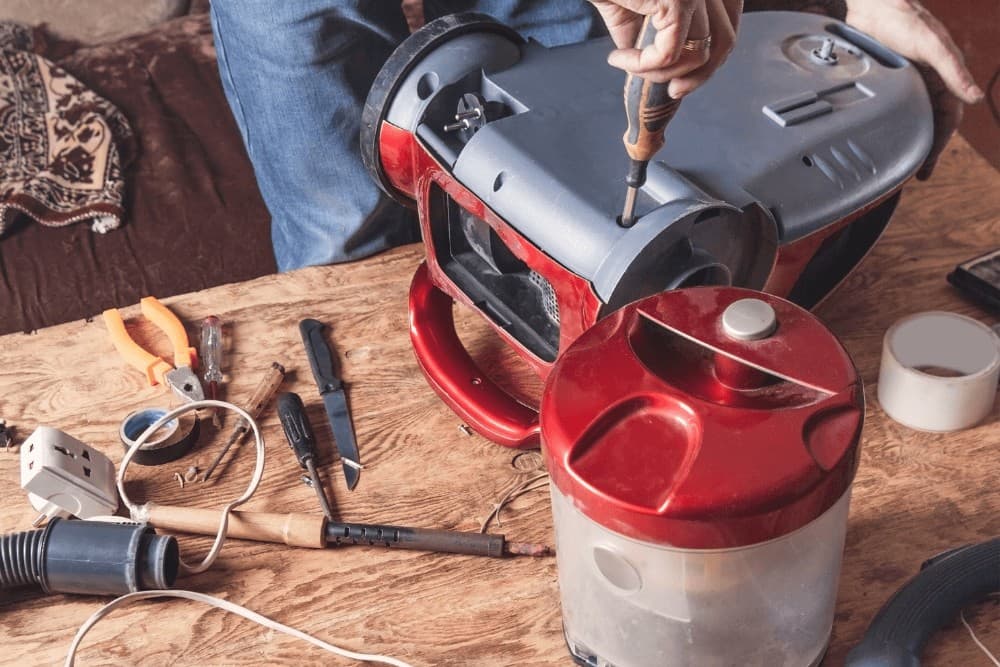
Most Dyson vacuum problems in Abu Dhabi come down to one of three things: suction that's dropped off, a brush bar that's stopped spinning, or a battery that won't hold charge past a few minutes — and all three are usually fixable without buying a new unit. What's different about repairing a Dyson here isn't the fault pattern itself, which is largely the same worldwide, but three things that genuinely change with the market: genuine parts take longer to arrive than UK or US guides assume, the counterfeit battery market for Dyson's cordless range is a real problem worth knowing about before you buy a replacement anywhere, and marble and tile floors — the norm in most Abu Dhabi homes — wear a Dyson differently than the carpet most troubleshooting guides are written for. Here's what actually goes wrong, what it costs to fix properly, and when repair stops making financial sense against a new unit.
The Three Faults That Cover Most Dyson Repairs
The vast majority of Dyson repair calls we get fall into three categories, and none of them mean the whole machine is finished.
| Fault | What's actually happening | Fixable? |
|---|---|---|
| Suction has dropped off | Almost always a clogged pre-motor filter or a blocked cyclone assembly — not the motor itself. Dyson's cyclone separation only works properly with clean airflow through the whole path, so a blockage anywhere from the cleaner head to the filter reads as generic "lost suction" even when the actual clog is somewhere specific. | Yes — usually a clean or clear, not a part replacement |
| Brush bar has stopped spinning | Either hair and thread wound tight enough to stall the brush motor, or the brush bar drive belt has worn through — belts are a wear item on every brush-bar vacuum ever made, Dyson included, and aren't a sign of a bigger fault. | Yes — belt replacement is routine, not exceptional |
| Battery won't hold charge past a few minutes | Lithium-ion cells degrade with charge cycles regardless of brand — this is chemistry, not a defect, and it's the single most common reason a cordless Dyson comes in for repair once it's past 3–4 years old. | Yes, with a genuine-equivalent replacement pack |
Suction has dropped off
Almost always a clogged pre-motor filter or a blocked cyclone assembly — not the motor itself. Dyson's cyclone separation only works properly with clean airflow through the whole path, so a blockage anywhere from the cleaner head to the filter reads as generic "lost suction" even when the actual clog is somewhere specific.
Yes — usually a clean or clear, not a part replacement
Brush bar has stopped spinning
Either hair and thread wound tight enough to stall the brush motor, or the brush bar drive belt has worn through — belts are a wear item on every brush-bar vacuum ever made, Dyson included, and aren't a sign of a bigger fault.
Yes — belt replacement is routine, not exceptional
Battery won't hold charge past a few minutes
Lithium-ion cells degrade with charge cycles regardless of brand — this is chemistry, not a defect, and it's the single most common reason a cordless Dyson comes in for repair once it's past 3–4 years old.
Yes, with a genuine-equivalent replacement pack
A smaller share of calls are electronic — a control board fault, a charging port that's stopped making contact, or (on the higher-end V11/V15 models specifically) the LCD screen or particle-sensor assembly. These cost more to fix and are the ones most worth weighing against the cost of a newer unit, covered in the repair-or-replace section further down.
When to Stop Using It and Book Immediately
Most of what goes wrong with a Dyson is a performance issue, not a safety one — a battery running down faster than it used to isn't dangerous, just annoying. A short list of signs is worth treating differently, because they point to a battery or electrical fault rather than ordinary wear:
- The battery or the machine body feels noticeably hot during use or while charging, beyond the mild warmth that's normal for any lithium-ion device.
- Any swelling or deformation in the battery pack housing — a genuine sign of cell failure, not something to keep charging and hope resolves itself.
- A burning smell from the motor or battery area, even briefly — stop and unplug or remove the battery immediately.
- Visible sparking at the charging port or power connection.
Any one of these means stop using it and book an inspection — don't keep charging or running the machine to "see if it gets worse." For everything else on this page — weaker suction, a stalled brush bar, reduced runtime — the machine is safe to keep using in the meantime while you arrange a repair.
Why Dyson Repairs Cost More to Get Right Than Other Vacuum Brands
A Hoover or Karcher belt-and-filter repair and a Dyson battery replacement look similar on the surface — both are a technician swapping a worn part — but the parts market underneath them isn't the same, and that's worth understanding before you book anywhere, not just with us.
Dyson's cordless range uses proprietary battery packs, and because genuine packs cost more than a budget vacuum's entire replacement part catalogue, a large aftermarket of compatible third-party batteries has grown around it — some genuinely fine, a meaningful share not. A pack built with lower-grade cells can undercharge, overheat, or simply not hold the capacity it's rated for, and there's no way to tell from the outside which category a given aftermarket pack falls into until it's already in your machine.
This is a genuinely different risk profile than a brush-bar belt or a filter, where a cheaper aftermarket part is mostly just a quality trade-off. A battery pack sits close to the machine's electronics and handles real current — worth being deliberate about where the replacement actually comes from, which is why we're specific about this later on this page rather than just saying "genuine parts" as a marketing line.
The other cost driver is simply that Dyson's engineering is denser than most competing brands — a digital motor spinning at far higher RPM than a standard vacuum motor, a cyclone separation system with more precision-machined parts than a simple bag-and-filter design, and (on cordless models) a battery management system that's more sophisticated than a basic charge controller. None of that makes Dyson repair complicated in a way that should scare you off — it's still a diagnosable, fixable machine — but it's why a Dyson technician needs more specific familiarity with the platform than general vacuum experience alone provides.
That higher motor speed is worth understanding concretely, not just as a marketing spec: Dyson's digital motors typically run well above 100,000 RPM, compared to a few thousand RPM on a conventional vacuum motor. Spinning that fast puts real stress on the bearings and balance of the motor assembly, and it's part of why a Dyson motor fault — while less common than a filter or battery issue — is also the single costliest part to replace on the machine. It also means a motor that sounds noticeably different (a new whine or rattle rather than the usual smooth high-pitched hum) is worth having checked promptly rather than waiting for it to fail outright, since a bearing issue caught early is a cheaper fix than one that's been left to damage the motor housing around it.
Marble Floors, Desert Dust: Why Dyson Vacuums Wear Differently in Abu Dhabi Homes
Most Dyson troubleshooting content online is written for UK and US homes, which are carpet-heavy — and that assumption changes what actually wears out first, in a way that's worth knowing if you're trying to work out what's wrong before booking.
Abu Dhabi homes run overwhelmingly on marble, tile, and hard flooring rather than carpet. That changes the wear pattern in two specific ways. First, the brush bar — the part every UK/US guide assumes is working hardest against carpet pile — sees comparatively light wear here, since a hard floor doesn't grip and drag at the bristles the way carpet fibre does. Second, and less obviously, a Dyson run mostly on hard floor relies on the cyclone and filter system doing more of the actual work, since there's no carpet fibre pre-filtering larger debris before it reaches the machine — fine dust and sand go straight into the airflow path. That shifts the typical fault pattern here toward filter and cyclone-related suction loss earlier in a machine's life than the brush-bar wear that dominates UK/US repair guides.
The dust itself matters too, and not in the generic way most local competitors mention it. Abu Dhabi's fine desert sand is a genuinely different particle size and composition from typical UK/US household dust — finer, and more prone to working into seals and gaskets rather than just sitting on filter mesh the way coarser dust does. That's part of why filter cleaning on a schedule that would be generous in London or Toronto is often not frequent enough here, and why a machine that seems to lose suction "too early" compared to what online reviews suggest often isn't a defect — it's the climate.
None of this changes how the machine gets fixed once something's actually wrong. It does change what we check first on a Dyson that comes in from an Abu Dhabi household versus the assumptions baked into most troubleshooting content written elsewhere.
Model-by-Model — What Actually Differs From a Repair Standpoint
Early cordless (V6–V8)
V6, V7, V8
Simplest cordless architecture, cheapest genuine batteries of the cordless range, and the generation most likely to be past the point where repair beats replacement on an electronics fault — though a battery-only swap is still almost always worth it.
Mid cordless (V10–V11)
V10, V11
The most common generation we see in Abu Dhabi currently. Digital motor and battery management are more sophisticated than V6–V8, and V11's LCD screen is a specific extra failure point neither earlier nor corded models have.
Latest cordless (V15 and newer)
V15 Detect and newer
Adds a laser dust-detection assembly and particle sensor on top of everything V11 has — genuinely useful features, and genuinely more that can develop a fault. Still repairable, but diagnosis takes longer given the added sensor and laser-emitter components.
Corded (Ball, Multi Floor, and similar)
Ball series, corded uprights
No battery to fail, which removes the single most common cordless fault category entirely. Ball-steering mechanism wear and cord-rewind faults are this range's equivalent recurring issue.
The practical takeaway: if you're not sure which generation you have, the model number is usually printed on a small plate on the underside of the machine or inside the bin area — worth checking before you call, since it changes both the likely fault and the realistic price range.
One thing that doesn't change across generations: the core diagnostic process. Every Dyson gets the same systematic check — airflow path, filter condition, brush bar, and (on cordless models) battery health — regardless of how new or old it is. What changes is which of those checks turns up the actual fault most often for that specific generation.
How Much Does Dyson Repair Cost in Abu Dhabi?
None of the local competitors we could find publish actual pricing — every one of them is a "call for a quote" page. Here's a realistic range to plan around, based on genuine and genuine-equivalent parts costs plus standard diagnostic and labour time.
| Job | Typical AED range | Notes |
|---|---|---|
| Diagnostic visit | AED 50 – 100 | Often credited toward the repair if you proceed |
| Filter clean / cyclone clear | AED 100 – 150 | Often resolves a suction complaint entirely — no parts needed |
| Brush bar belt replacement | AED 120 – 220 | Routine wear item, not a sign of a bigger fault |
| Battery replacement — V6–V8 | AED 250 – 400 | Genuine-equivalent pack, generation-specific |
| Battery replacement — V10–V11 | AED 350 – 550 | Higher-capacity pack costs more than earlier generations |
| Battery replacement — V15 | AED 450 – 650 | Newest, highest-capacity pack in the cordless range |
| Motor replacement | AED 400 – 800 | Less common than filter/battery faults, but the highest single-part cost on a Dyson |
| Control board / LCD (V11, V15) | AED 350 – 700 | Depends on which specific component has failed |
Diagnostic visit
AED 50 – 100
Often credited toward the repair if you proceed
Filter clean / cyclone clear
AED 100 – 150
Often resolves a suction complaint entirely — no parts needed
Brush bar belt replacement
AED 120 – 220
Routine wear item, not a sign of a bigger fault
Battery replacement — V6–V8
AED 250 – 400
Genuine-equivalent pack, generation-specific
Battery replacement — V10–V11
AED 350 – 550
Higher-capacity pack costs more than earlier generations
Battery replacement — V15
AED 450 – 650
Newest, highest-capacity pack in the cordless range
Motor replacement
AED 400 – 800
Less common than filter/battery faults, but the highest single-part cost on a Dyson
Control board / LCD (V11, V15)
AED 350 – 700
Depends on which specific component has failed
These are market-informed estimates, not fixed prices — get a firm quote after an in-person diagnosis, and treat any quote given without seeing the machine with some caution, since the exact fault (not just the symptom) is what actually determines cost.
Genuine vs. Third-Party Batteries — What We Actually Fit
Given the counterfeit and low-grade battery market described above, it's worth being specific about what "genuine-equivalent" actually means here rather than leaving it vague.
We fit genuine Dyson battery packs where they're available and priced reasonably against the repair's overall value, and a small number of vetted direct-equivalent packs from cell manufacturers we've tested ourselves — not the cheapest aftermarket option available, which is usually where the risk described above actually lives. If a genuine pack isn't available or reasonably priced for your specific model, we'll say so plainly rather than quietly substituting something lower-grade and charging genuine-part pricing for it.
A rough way to tell a properly-built replacement pack from a bargain one before it's fitted: genuine and quality-equivalent packs list actual cell specifications (capacity in mAh, cell brand) rather than just "compatible with Dyson V11" on the packaging, and they cost within a reasonable range of genuine pricing rather than a fraction of it — a pack priced at a third of genuine cost is cutting corners somewhere in the cell quality, and that corner usually shows up as reduced runtime or premature failure within months rather than years.
None of this is to say every aftermarket battery is a problem — it's a genuinely large, mixed market, and "aftermarket" isn't itself a red flag. It's specifically the bottom end of that market, sold on price alone with no cell specification disclosed, that's worth avoiding regardless of who fits it.
Repair or Replace? A Real Framework
The general rule used across this site — repair makes sense up to roughly 60–70% of a new equivalent unit's cost — applies to Dyson too, but the numbers look different because Dyson's own price range is wider than most appliance categories.
Almost always worth repairing
A filter clean, belt, or single battery replacement on any Dyson, regardless of age — even the priciest battery swap above sits well under a third of what a new equivalent model costs.
Worth pausing on
A motor replacement on a machine past 5–6 years old — AED 400–800 against a new mid-range Dyson running roughly AED 1,800–2,500 puts a motor repair on an older unit in the range worth weighing, not an automatic yes.
Usually the clearer replace signal
A control board or LCD fault on a machine already showing other wear (weak suction that persists after cleaning, a battery also near end of life) — stacking two repairs is where the economics tip against fixing.
New Dyson pricing in the UAE runs roughly AED 1,200–1,800 for entry cordless models, AED 1,800–2,800 for mid-range (V11-equivalent), and AED 2,800–3,800+ for the latest V15-generation models — useful context for judging any of the repair costs above against buying new, though a refurbished or previous-generation new unit is often a middle option worth asking about too, at a meaningful discount to current-generation pricing.
A worked example: a 4-year-old V10 with a battery that now runs 4 minutes on full power instead of the 20+ it once did. Diagnostic confirms it's genuinely the battery, not a filter or airflow issue masquerading as a runtime problem. A genuine-equivalent V10 pack runs AED 350–550 installed — against a new V11-equivalent replacement at AED 1,800–2,800, that repair sits comfortably under the 60–70% threshold, and the rest of the machine (motor, cyclone, brush bar) has no reported issues to weigh against it. Straightforward repair call. Change one detail — say the motor is also making a new whine, or the machine is closer to 7 years old with a prior board repair already on record — and the calculation shifts toward at least seriously comparing the cost of a new unit before committing to a second repair on the same machine.
The honest version of this advice, which most repair companies won't volunteer: if a technician quotes a repair that's clearly closer to replacement cost than the 60–70% threshold suggests, ask directly whether they'd recommend it themselves before agreeing — a repairer with nothing to gain from steering you either way should be willing to answer that plainly.
Are We an Authorized Dyson Service Center?
No — and we'd rather say that plainly than let the question sit ambiguous, since a few competitors in this market blur the line. One Click Technicians is an independent appliance repair company, not a Dyson-authorized service center, and we don't claim to be one.
What that means in practice: your Dyson's manufacturer warranty, if it's still within its coverage period, is best handled through Dyson's own official channels first, since an independent repair — even a careful one — can affect warranty coverage depending on the specific terms. For a machine still under warranty with a genuine fault, check your warranty status before booking an independent repair.
For anything past warranty, which covers the majority of the repairs we actually do — batteries degrading after 3+ years, filters and belts wearing with normal use, faults on older machines — independent repair is both faster and usually meaningfully cheaper than the manufacturer channel, without any compromise on doing the job properly. We're specific about genuine and genuine-equivalent parts for exactly this reason: independent shouldn't mean lower standard, just a different (and often better-value) route once warranty isn't the deciding factor.
What Happens When You Book
- 1
Call or book online
Describe the symptom and your model if you know it — the generation genuinely changes what we check first.
- 2
The same systematic check every visit
Airflow path, filter, brush bar, and battery health on cordless models — regardless of what you think the fault is, since the reported symptom and the actual cause aren't always the same thing.
- 3
A fixed price before anything is replaced
Based on the actual fault found, not the symptom you called about.
Most repairs — filter clean, belt, single battery swap — are completed on the same visit. Anything needing a part we don't carry on the van (less common, mostly control-board-level faults) gets a clear timeline before you commit, not an open-ended "we'll let you know."
Frequently Asked Questions
How much does Dyson servicing cost in Abu Dhabi?
Is there a Dyson repair center near me in Abu Dhabi?
Why has my Dyson lost suction even though I clean the filter regularly?
How long do Dyson batteries actually last before needing replacement?
Is it safe to buy a cheap aftermarket Dyson battery online?
Do you repair the Dyson V15's laser and particle sensor?
Is it worth repairing an older Dyson, or should I just replace it?
Are you an authorized Dyson service center?
Is it dangerous to keep using a Dyson with a battery fault?
Ready When You Are
Dyson not working right? Get it fixed properly.
Fixed price confirmed before any work starts. Licensed technicians, 90-day workmanship warranty.