Mitsubishi Electric Specialist · Same-Day
Mitsubishi Electric AC Repair in Abu Dhabi
Mr. Slim split, ducted, or City Multi VRF — Mitsubishi Electric AC diagnosed against its actual documented fault codes, not generic cross-brand guesses, with a fixed price confirmed before any work starts.
Mr. Slim, Ducted, and City Multi — Mitsubishi Electric's Product Lines Explained
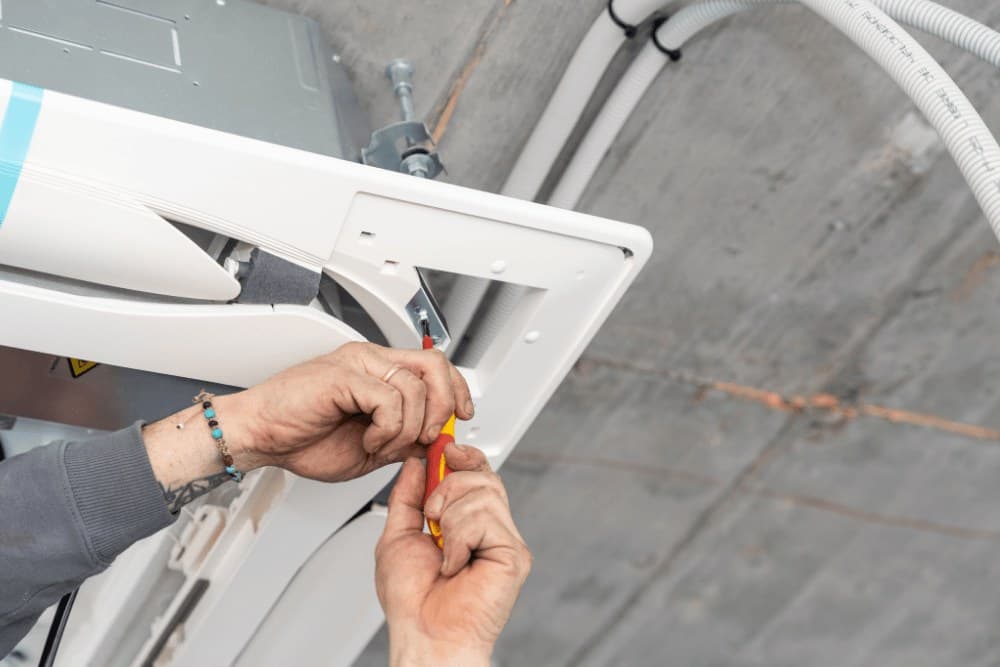
Mitsubishi Electric AC systems in Abu Dhabi split across three genuinely different categories: standard split units (marketed as the Mr. Slim range in most of Mitsubishi Electric's UAE literature), ducted units run from a single indoor air handler, and City Multi VRF (Variable Refrigerant Flow) commercial systems where one or more outdoor condensers feed multiple indoor units across an office, retail space, or larger villa. The three share a family resemblance in fault-code logic but aren't identical, and getting this right before diagnosis starts is the same first step we'd apply to any multi-line brand — a VRF branch fault and a single split unit's compressor fault look nothing alike once you're past the initial symptom.
Most current-generation Mitsubishi Electric split units run inverter compressors, with the outdoor unit's control board continuously varying compressor speed to match cooling demand rather than cycling fully on and off. Mitsubishi Electric's fault-code system reflects this directly: a meaningful share of the codes relate to communication between the indoor and outdoor units' control boards (E6, E7, E9, EE) rather than to the compressor or refrigerant circuit themselves, because so much of an inverter system's behavior depends on the two boards agreeing on what the compressor should be doing at any given moment.
Communication faults specifically are worth understanding on their own, because they get misread constantly. A code pointing to "indoor/outdoor communication error" doesn't mean either board has necessarily failed — it more often means the signal between them has been interrupted, whether by a loose or corroded connector, damaged interconnecting cable, or (less often) a genuine board fault on one side. Testing the actual wiring run before assuming either control board needs replacing is standard practice, and it's the difference between a same-visit fix and an unnecessarily expensive parts order.
City Multi VRF systems extend the same indoor/outdoor communication logic across a branch network — refrigerant and control signals both route through branch joints and, on larger installs, controller boxes serving groups of indoor units. As with any VRF system, the critical early question is whether a fault is isolated to one indoor unit and its branch or affects the shared outdoor system, since the answer changes both the diagnostic approach and the cost by a wide margin.
Mitsubishi Electric's remote controllers vary by generation and range — simple wireless remotes on residential Mr. Slim splits show a basic display, sometimes with no fault code at all on older units, while wired controllers common on ducted and City Multi installs display a longer code and occasionally a short description. On models with no display code whatsoever, Mitsubishi Electric units — like most brands — fall back to a specific LED blink pattern on the indoor unit itself, and counting that pattern accurately (how many blinks, how long the pause between groups) is often the only diagnostic information available before a technician arrives.
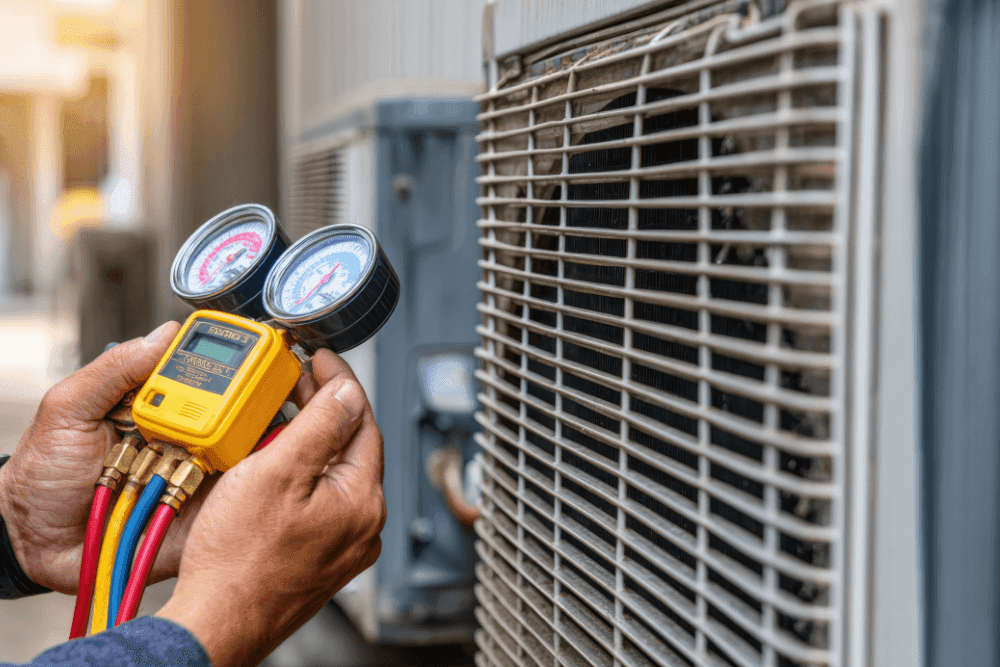
Most Mitsubishi Electric split units installed in the UAE over the past several years run on R32 refrigerant, Mitsubishi Electric's standard for current-generation Mr. Slim models, with older units still running R410A. R32 is more energy-efficient but mildly flammable, and any leak repair or top-up on an R32 system needs certified handling equipment and procedures distinct from R410A work. We confirm which refrigerant your specific unit runs before any gas work — the two can't be mixed or substituted regardless of what's available on the day.
Which Mitsubishi Electric AC Systems We See Most in Abu Dhabi
Mr. Slim wall-mounted split (MSZ / MUZ series)
The standard residential installation across Abu Dhabi apartments and villas — one indoor wall unit, one outdoor condenser, inverter compressor. The large majority of our Mitsubishi Electric call-outs are this category, and most first-visit fixes are a communication fault, sensor, or gas leak rather than compressor replacement.
Ducted / concealed units (SEZ series)
Common in villas and larger apartments, run from a concealed indoor air handler through ductwork. Diagnosis starts at the air handler's control board and wired remote's fault code before tracing further if the fault points into the duct system.
City Multi VRF commercial systems
Standard in offices, retail units, and some larger villas, where one or more outdoor condensers feed multiple indoor units through a branch network. Fault isolation — one indoor unit versus the shared system — is the essential first diagnostic step; see our commercial page for full VRF system coverage. See our commercial AC & chiller repair page.
Older non-inverter split units
Still running in some older buildings. Simpler control logic than a current inverter model, sometimes with no digital fault display, meaning diagnosis works from the symptom table further down this page rather than a code.
Mitsubishi Electric Fault Codes, Explained Properly
This is Mitsubishi Electric's documented fault-code set for residential split and ducted systems, grouped by what's actually failing rather than listed alphabetically — communication faults, sensor faults, and compressor/pressure faults each point toward a different part of the system and a different repair cost.
| Code | Fault | Likely cause | DIY-checkable? | Typical fix |
|---|---|---|---|---|
| E0 | System transmission error | A communication fault between the indoor unit and its remote controller — distinct from an indoor/outdoor unit fault. | Yes — check remote batteries and signal path first | Fresh batteries or clearing an obstruction between remote and receiver resolves a real share of these; a persistent E0 needs the receiver module tested. |
| E6 / E7 | Indoor/outdoor unit communication error | The indoor and outdoor control boards aren't communicating correctly — a loose connector, damaged interconnecting cable, or occasionally a board fault on either side. | Partially — reset at breaker first | We test the interconnecting cable and connectors before assuming either control board has failed — this is the single most over-diagnosed fault category on this brand. |
| E9 | Indoor/outdoor communication error (outdoor-side) | The same communication fault category as E6/E7, flagged specifically from the outdoor unit's side of the link. | Partially — reset at breaker first | Same wiring-first diagnostic approach as E6/E7 before any board replacement is quoted. |
| EE | Communication error between indoor and outdoor units | A broader version of the same communication fault, used on some model generations in place of the E6/E7/E9 set. | Partially — reset at breaker first | Wiring and connector inspection first, board testing second. |
| P1 | Intake air sensor fault | The sensor reading the temperature of air entering the indoor unit has failed or lost connection. | No — needs sensor testing | Sensor testing and replacement — an inexpensive part, but one the system needs to regulate the cycle correctly. |
| P2 / P9 | Refrigerant pipe sensor fault | A thermistor monitoring the liquid or two-phase refrigerant pipe temperature has failed. | No — needs sensor testing | Sensor testing and replacement, specific to which pipe sensor is flagged. |
| P4 | Drain sensor fault | The sensor monitoring condensate drain water level isn't reading correctly — sometimes a genuine sensor fault, sometimes a blocked drain line triggering it. | Yes — check the drain line first | Clearing the condensate drain resolves a meaningful share of these before any sensor replacement is needed. |
| P5 | Drain pump fault / high condensate level | The drain pump isn't clearing condensate fast enough, or has failed outright — usually paired with visible water pooling or dripping. | Yes — check for a blocked or kinked drain line first | Drain line clearance first; a persistent P5 with a clear line needs the drain pump itself tested. |
| P6 | Freeze/overheat safeguard activated | The system has shut down to protect against icing or overheating — usually restricted indoor airflow from a dirty filter, sometimes low refrigerant. | Yes — clean the filter first | A clean filter resolves this in many cases; a fault that persists past a clean filter points toward refrigerant charge. |
| P8 | Pipe temperature error | Refrigerant pipe temperature outside the expected operating range for current conditions. | No — needs pressure and sensor testing | Technician checks refrigerant charge and pipe sensor readings together to isolate the actual cause. |
| U2 | Abnormally high discharge temperature / low refrigerant | The compressor's discharge temperature is running higher than the system allows — most often insufficient refrigerant from a leak. | No — needs leak detection | Leak detection and repair before any recharge, not just a top-up. |
| U3 / U4 | Outdoor unit thermistor open or short circuit | A temperature sensor in the outdoor unit has failed electrically — an open or shorted circuit rather than a reading-accuracy issue. | No — needs sensor testing | Sensor testing and replacement. |
| U6 | Compressor overcurrent interruption | The compressor has drawn current beyond its safe limit and shut down to protect itself — a starting fault, failing capacitor, or genuine compressor issue. | No — electrical diagnosis needed | Capacitor testing first, since it's the more common and cheaper cause; compressor testing only if the capacitor checks out. |
| UP | Compressor overcurrent interruption (alternate code) | The same overcurrent protection category as U6, used on some model generations. | No — electrical diagnosis needed | Same capacitor-first diagnostic approach as U6. |
| UF | Compressor overcurrent interruption (compressor locked) | A more severe version of the U6/UP overcurrent fault, indicating the compressor itself may be mechanically locked or seized. | No — needs compressor diagnosis | This is the one code in the overcurrent family that more reliably points toward the compressor itself rather than the capacitor or starting circuit — still tested to confirm before quoting replacement. |
| Ud | Abnormal high pressure / overheating safeguard | System pressure or temperature has exceeded a safe threshold and shut the unit down protectively. | Yes — check outdoor unit clearance and coil cleanliness first | Clear obstructions and check the outdoor coil for dust buildup before assuming a refrigerant charge issue. |
E0 — System transmission error
- Likely cause
- A communication fault between the indoor unit and its remote controller — distinct from an indoor/outdoor unit fault.
- DIY-checkable?
- Yes — check remote batteries and signal path first
- Typical fix
- Fresh batteries or clearing an obstruction between remote and receiver resolves a real share of these; a persistent E0 needs the receiver module tested.
E6 / E7 — Indoor/outdoor unit communication error
- Likely cause
- The indoor and outdoor control boards aren't communicating correctly — a loose connector, damaged interconnecting cable, or occasionally a board fault on either side.
- DIY-checkable?
- Partially — reset at breaker first
- Typical fix
- We test the interconnecting cable and connectors before assuming either control board has failed — this is the single most over-diagnosed fault category on this brand.
E9 — Indoor/outdoor communication error (outdoor-side)
- Likely cause
- The same communication fault category as E6/E7, flagged specifically from the outdoor unit's side of the link.
- DIY-checkable?
- Partially — reset at breaker first
- Typical fix
- Same wiring-first diagnostic approach as E6/E7 before any board replacement is quoted.
EE — Communication error between indoor and outdoor units
- Likely cause
- A broader version of the same communication fault, used on some model generations in place of the E6/E7/E9 set.
- DIY-checkable?
- Partially — reset at breaker first
- Typical fix
- Wiring and connector inspection first, board testing second.
P1 — Intake air sensor fault
- Likely cause
- The sensor reading the temperature of air entering the indoor unit has failed or lost connection.
- DIY-checkable?
- No — needs sensor testing
- Typical fix
- Sensor testing and replacement — an inexpensive part, but one the system needs to regulate the cycle correctly.
P2 / P9 — Refrigerant pipe sensor fault
- Likely cause
- A thermistor monitoring the liquid or two-phase refrigerant pipe temperature has failed.
- DIY-checkable?
- No — needs sensor testing
- Typical fix
- Sensor testing and replacement, specific to which pipe sensor is flagged.
P4 — Drain sensor fault
- Likely cause
- The sensor monitoring condensate drain water level isn't reading correctly — sometimes a genuine sensor fault, sometimes a blocked drain line triggering it.
- DIY-checkable?
- Yes — check the drain line first
- Typical fix
- Clearing the condensate drain resolves a meaningful share of these before any sensor replacement is needed.
P5 — Drain pump fault / high condensate level
- Likely cause
- The drain pump isn't clearing condensate fast enough, or has failed outright — usually paired with visible water pooling or dripping.
- DIY-checkable?
- Yes — check for a blocked or kinked drain line first
- Typical fix
- Drain line clearance first; a persistent P5 with a clear line needs the drain pump itself tested.
P6 — Freeze/overheat safeguard activated
- Likely cause
- The system has shut down to protect against icing or overheating — usually restricted indoor airflow from a dirty filter, sometimes low refrigerant.
- DIY-checkable?
- Yes — clean the filter first
- Typical fix
- A clean filter resolves this in many cases; a fault that persists past a clean filter points toward refrigerant charge.
P8 — Pipe temperature error
- Likely cause
- Refrigerant pipe temperature outside the expected operating range for current conditions.
- DIY-checkable?
- No — needs pressure and sensor testing
- Typical fix
- Technician checks refrigerant charge and pipe sensor readings together to isolate the actual cause.
U2 — Abnormally high discharge temperature / low refrigerant
- Likely cause
- The compressor's discharge temperature is running higher than the system allows — most often insufficient refrigerant from a leak.
- DIY-checkable?
- No — needs leak detection
- Typical fix
- Leak detection and repair before any recharge, not just a top-up.
U3 / U4 — Outdoor unit thermistor open or short circuit
- Likely cause
- A temperature sensor in the outdoor unit has failed electrically — an open or shorted circuit rather than a reading-accuracy issue.
- DIY-checkable?
- No — needs sensor testing
- Typical fix
- Sensor testing and replacement.
U6 — Compressor overcurrent interruption
- Likely cause
- The compressor has drawn current beyond its safe limit and shut down to protect itself — a starting fault, failing capacitor, or genuine compressor issue.
- DIY-checkable?
- No — electrical diagnosis needed
- Typical fix
- Capacitor testing first, since it's the more common and cheaper cause; compressor testing only if the capacitor checks out.
UP — Compressor overcurrent interruption (alternate code)
- Likely cause
- The same overcurrent protection category as U6, used on some model generations.
- DIY-checkable?
- No — electrical diagnosis needed
- Typical fix
- Same capacitor-first diagnostic approach as U6.
UF — Compressor overcurrent interruption (compressor locked)
- Likely cause
- A more severe version of the U6/UP overcurrent fault, indicating the compressor itself may be mechanically locked or seized.
- DIY-checkable?
- No — needs compressor diagnosis
- Typical fix
- This is the one code in the overcurrent family that more reliably points toward the compressor itself rather than the capacitor or starting circuit — still tested to confirm before quoting replacement.
Ud — Abnormal high pressure / overheating safeguard
- Likely cause
- System pressure or temperature has exceeded a safe threshold and shut the unit down protectively.
- DIY-checkable?
- Yes — check outdoor unit clearance and coil cleanliness first
- Typical fix
- Clear obstructions and check the outdoor coil for dust buildup before assuming a refrigerant charge issue.
City Multi VRF commercial systems share this same code family but add branch-network and controller-box specific faults not covered here — if your building runs a multi-zone Mitsubishi Electric commercial system rather than a single split or ducted unit, see our commercial AC & chiller page for VRF-specific diagnosis.
No Digital Code? Diagnose by Symptom
Older Mitsubishi Electric units and some models with basic wireless remotes don't show an alphanumeric fault code — this is how we work from symptoms and LED blink patterns instead.
| Symptom | Likely cause | What to do |
|---|---|---|
| Fan runs, compressor stays silent | A failing start capacitor — the most common cause of exactly this pattern regardless of the inverter electronics involved. | Worth checking before assuming a communication or compressor fault; the fan doesn't need the same starting surge the compressor does. |
| Unit powers on but display or indoor LED won't stop blinking | An active fault the control board is signaling through a blink pattern rather than an alphanumeric code — common on Mr. Slim models without a full display. | Count the blink pattern exactly (number of blinks, length of pause) and describe it when you call; it's often the only diagnostic detail available before a technician arrives. |
| Unit runs constantly, never reaches set temperature | Low refrigerant from a leak, or a dust-blocked outdoor coil restricting heat exchange. | Check when the outdoor coil was last cleaned; persistent underperformance with a clean coil points toward refrigerant. |
| Hissing sound near an indoor or outdoor unit joint | Refrigerant escaping under pressure — an active leak on any Mitsubishi Electric model, not a normal operating sound. | Worth a same-week booking; R32 systems specifically need certified leak-detection equipment given the refrigerant's mild flammability. |
| Unit trips the breaker repeatedly | A failing capacitor, a shorted compressor winding, or a genuine electrical fault in the outdoor unit's wiring. | Don't keep resetting and running the unit — repeated trips indicate a real electrical fault, not a nuisance to reset past. |
| Water dripping from the indoor unit | A blocked condensate drain line — the most common cause across every Mitsubishi Electric split and ducted model. | Usually a same-visit fix; clearing the line resolves most of these without needing the drain pump or sensor replaced. |
| One indoor unit on a City Multi system not cooling while others work fine | A fault isolated to that indoor unit or its branch, not the shared outdoor system — confirmed by the other zones working normally. | Mention only one zone is affected when you call; it narrows diagnosis toward that specific unit rather than the whole system. |
| Remote control unresponsive | Dead batteries on a wireless remote, or a signal-path obstruction between remote and receiver — rarely the AC system itself. | Replace batteries and check line of sight to the receiver before assuming a bigger fault. |
| Musty smell when the unit starts running | Mold or bacterial growth on the indoor coil or drain pan, more pronounced in Abu Dhabi's humidity than drier climates. | A coil and drain-pan clean resolves this in most cases — see our AC musty smell guide for the full cause breakdown. |
| Outdoor unit noticeably louder than when new | A failing fan motor bearing, a loose panel, or debris caught in the outdoor fan. | Check for visible debris first; a bearing or motor fault needs a technician, and the specific sound narrows the cause considerably. |
Fan runs, compressor stays silent
- Likely cause
- A failing start capacitor — the most common cause of exactly this pattern regardless of the inverter electronics involved.
- What to do
- Worth checking before assuming a communication or compressor fault; the fan doesn't need the same starting surge the compressor does.
Unit powers on but display or indoor LED won't stop blinking
- Likely cause
- An active fault the control board is signaling through a blink pattern rather than an alphanumeric code — common on Mr. Slim models without a full display.
- What to do
- Count the blink pattern exactly (number of blinks, length of pause) and describe it when you call; it's often the only diagnostic detail available before a technician arrives.
Unit runs constantly, never reaches set temperature
- Likely cause
- Low refrigerant from a leak, or a dust-blocked outdoor coil restricting heat exchange.
- What to do
- Check when the outdoor coil was last cleaned; persistent underperformance with a clean coil points toward refrigerant.
Hissing sound near an indoor or outdoor unit joint
- Likely cause
- Refrigerant escaping under pressure — an active leak on any Mitsubishi Electric model, not a normal operating sound.
- What to do
- Worth a same-week booking; R32 systems specifically need certified leak-detection equipment given the refrigerant's mild flammability.
Unit trips the breaker repeatedly
- Likely cause
- A failing capacitor, a shorted compressor winding, or a genuine electrical fault in the outdoor unit's wiring.
- What to do
- Don't keep resetting and running the unit — repeated trips indicate a real electrical fault, not a nuisance to reset past.
Water dripping from the indoor unit
- Likely cause
- A blocked condensate drain line — the most common cause across every Mitsubishi Electric split and ducted model.
- What to do
- Usually a same-visit fix; clearing the line resolves most of these without needing the drain pump or sensor replaced.
One indoor unit on a City Multi system not cooling while others work fine
- Likely cause
- A fault isolated to that indoor unit or its branch, not the shared outdoor system — confirmed by the other zones working normally.
- What to do
- Mention only one zone is affected when you call; it narrows diagnosis toward that specific unit rather than the whole system.
Remote control unresponsive
- Likely cause
- Dead batteries on a wireless remote, or a signal-path obstruction between remote and receiver — rarely the AC system itself.
- What to do
- Replace batteries and check line of sight to the receiver before assuming a bigger fault.
Musty smell when the unit starts running
- Likely cause
- Mold or bacterial growth on the indoor coil or drain pan, more pronounced in Abu Dhabi's humidity than drier climates.
- What to do
- A coil and drain-pan clean resolves this in most cases — see our AC musty smell guide for the full cause breakdown.
Outdoor unit noticeably louder than when new
- Likely cause
- A failing fan motor bearing, a loose panel, or debris caught in the outdoor fan.
- What to do
- Check for visible debris first; a bearing or motor fault needs a technician, and the specific sound narrows the cause considerably.
What Actually Breaks on a Mitsubishi Electric AC, and Why
Communication faults are the brand's single most over-diagnosed category
E6/E7/E9/EE-family codes point toward the signal link between indoor and outdoor boards, not necessarily either board itself. Testing the actual interconnecting wiring before assuming a board replacement catches a genuine share of cases where the real fault is a loose or corroded connector.
UF is the one overcurrent code that reliably means compressor
U6 and UP both flag compressor overcurrent protection that's frequently caused by a failing capacitor rather than the compressor itself — UF specifically, indicating a locked or seized compressor, is the more reliable signal of genuine compressor-level failure among the three.
Drain-related faults (P4, P5) get mistaken for sensor failures
Both codes can be triggered by a simple blocked drain line rather than a genuine sensor or pump fault — clearing the line first resolves a meaningful share of these calls before any part is replaced.
Dust accelerates outdoor coil faults here specifically
Abu Dhabi's ambient dust settles on outdoor condenser coils faster than in cleaner-air climates — a real, measurable reason coil-cleaning resolves so many "unit runs constantly" complaints on this brand locally.
R32 systems needing certified handling specifically
Because R32 is mildly flammable, any leak repair or top-up on an R32-charged Mitsubishi Electric unit needs different tools and certified procedures than older R410A systems.
City Multi single-branch faults are cheaper than people assume
Because VRF systems isolate faults to individual branches, a one-zone complaint on an otherwise-healthy City Multi system is usually a contained, moderate-cost repair rather than a whole-system job.
How We Diagnose a Mitsubishi Electric AC Fault
Read the fault code or count the blink pattern exactly
Wired controllers on ducted and City Multi installs show more detail than basic wireless remotes — the exact code or blink count helps us bring the right parts on the first visit.
Confirm split, ducted, or City Multi VRF before anything else
The three product lines share overlapping fault codes but diverge in real ways — getting this right first avoids quoting the wrong repair category.
Test communication wiring before replacing either control board
Given how often E6/E7/E9-family codes trace back to a wiring or connector fault rather than a genuine board failure, this step alone avoids a meaningful share of unnecessary parts orders.
Rule out the simple causes on-site
Filter, drain line, outdoor unit clearance, and breaker status are checked first — resolves a real share of call-outs without refrigerant work or parts.
Isolate single-zone versus whole-system on City Multi installs
Whether one indoor unit or the shared outdoor system is affected changes the diagnostic path and cost considerably.
Fixed price before any work starts
Once the fault is confirmed and isolated, you get an exact price for that specific repair — not an estimate that grows once the job is underway.
Mitsubishi Electric AC Repair Cost in Abu Dhabi
Every Mitsubishi Electric repair gets a fixed price confirmed on-site after diagnosis, before any work starts. Communication and sensor faults sit at the lower end and are among the most common issues we see on this brand; refrigerant leak repair and compressor replacement run higher given part cost. City Multi commercial pricing depends on whether a fault is isolated to one zone or affects the shared branch network — quoted separately once diagnosed.
Capacitor / fan motor
The most common minor Mitsubishi Electric split-unit fault
AED 150 – 350
Communication fault (wiring/connector)
Tested before assuming either control board needs replacing
AED 180 – 400
Sensor replacement (P1, P2, P4, P8)
Inexpensive parts the system depends on to regulate the cycle
AED 180 – 400
Drain pump replacement
Checked against a simple blocked drain line first
AED 220 – 450
Indoor or outdoor PCB replacement
Model dependent; tested rather than assumed
AED 350 – 750
Gas leak repair & refrigerant top-up
Depends on leak location and whether the unit runs R410A or R32
AED 250 – 650
Compressor replacement (split/ducted)
Depends on unit capacity and refrigerant type; confirmed by testing, not assumed from a code
AED 1,600 – 3,200+
City Multi single-zone/branch repair
Isolated to the affected indoor unit; confirmed before quoting
AED 400 – 1,000
See our general AC Repair page for other brands, or our AC Maintenance page for scheduled servicing.
Are You an Authorized Mitsubishi Electric Service Center?
We're not an authorized Mitsubishi Electric dealer, and it's worth being upfront about what that means. If your unit is still within its manufacturer warranty period, Mitsubishi Electric's own authorized network is the right first call — that coverage is free, and using an independent technician on a still-warrantied compressor can affect your claim. Past that point, an independent technician using genuine-equivalent parts typically gets to your home faster and charges less for the identical fault, using the same fault-diagnostic approach covered on this page.
Frequently Asked Questions
How much does Mitsubishi Electric AC repair cost in Abu Dhabi?
What does an E6 or E7 error mean on my Mitsubishi Electric AC?
What is Mr. Slim, and is it different from other Mitsubishi Electric AC models?
Does Mitsubishi Electric AC use R32 or R410A refrigerant?
What's the difference between a City Multi system and a standard split unit?
Are you an authorized Mitsubishi Electric service center?
My Mitsubishi Electric AC's indoor light keeps blinking — what does that mean?
Why does my Mitsubishi Electric AC's fan run but the compressor stays silent?
Do you do Mitsubishi Electric gas top-ups, or only full repairs?
What does the UF error code mean, and is it always the compressor?
Is it worth repairing an older Mitsubishi Electric unit, or should I replace it?
One zone of my City Multi system isn't cooling — is that a major repair?
Can I top up my Mitsubishi Electric AC's refrigerant myself?
Do you service Mitsubishi Electric ducted (SEZ series) systems?
Is same-day Mitsubishi Electric AC repair available in Abu Dhabi?
My remote shows nothing at all, not even a blink — what should I check first?
How is Mitsubishi Electric different from plain 'Mitsubishi' AC units sold in the UAE?
Why does my Mitsubishi Electric AC keep losing its wifi or app connection?
Areas We Cover for Mitsubishi Electric AC Repair
Ready When You Are
Book a Mitsubishi Electric-experienced technician today.
Fixed price confirmed before any work starts. Licensed technicians, 90-day workmanship warranty.