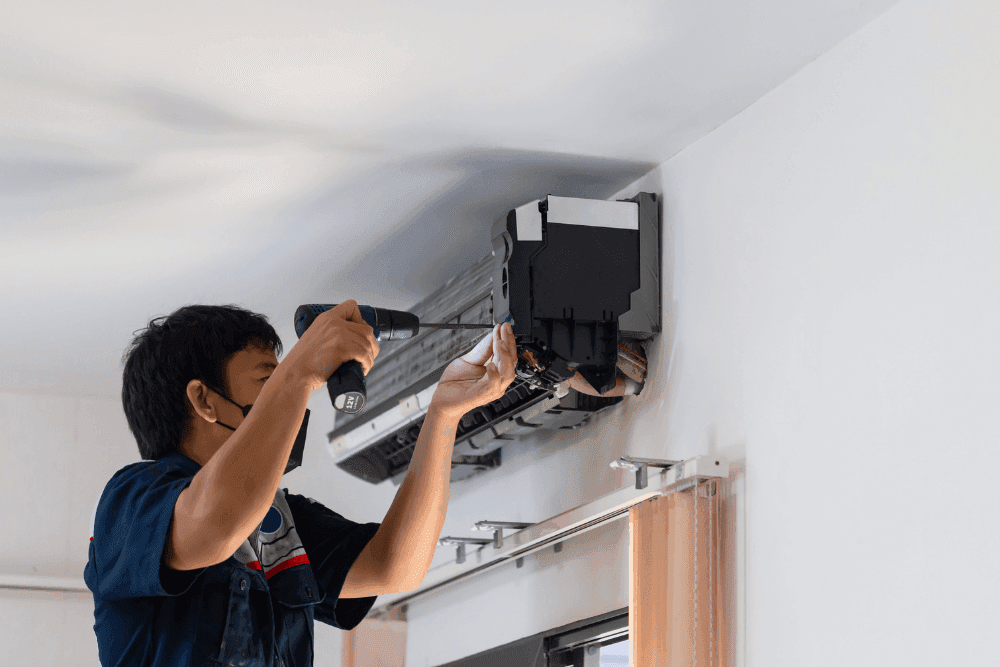
Water dripping from your indoor AC unit, running down a wall, or staining the ceiling below a concealed unit is one of the most common service calls we get in Abu Dhabi — and it's almost never a mystery once someone actually looks at it. Seven causes account for nearly every case. This guide walks through each one, what you can safely check yourself, what genuinely needs a technician, why it happens faster here than the generic guides written for milder climates assume, and what it costs to fix.
How your AC produces water in the first place
An air conditioner doesn't just cool air — it also pulls moisture out of it. Warm, humid room air passes over the indoor unit's evaporator coil, which is running cold enough that water vapor in the air condenses on it, the same way droplets form on a cold glass on a humid day. That water drips off the coil into a shallow drain pan underneath it, then flows out through a condensate drain line — a thin pipe, usually PVC, that carries it away to a floor drain, a balcony outlet, or straight outside.
That process runs constantly while the AC is cooling, and in Abu Dhabi's climate it produces a genuinely large volume of water — a single mid-size split unit can pull several litres of condensate out of the air on a humid day. None of that is a problem as long as the drain path stays clear and the coil stays at a normal operating temperature. A leak means water has stopped following that path and started finding another one instead — and there are only a handful of reasons that happens.
Diagnose your leak in 60 seconds
Before the detail below, this table maps what you're seeing to the most likely cause and how urgently it needs attention. It's a starting point, not a diagnosis — several causes can produce a similar symptom, which is exactly why a technician checks the drain, coil, and pan together rather than assuming from the symptom alone.
| What you're seeing | Most likely cause | How urgent |
|---|---|---|
| Steady drip from the indoor unit, AC still cooling normally | Blocked condensate drain line | Book normally — same-visit fix |
| Water only appears a few hours after the AC starts | Drain line slowly backing up, or coil icing then thawing | Book normally |
| Ice visible on the indoor unit or refrigerant pipes | Frozen evaporator coil — dirty filter, low refrigerant, or poor airflow | Switch off, let it thaw, book soon |
| Leak started right after installation or a ceiling repair | Incorrect drain slope or installation fault | Book normally, mention the timing |
| Same spot leaks again shortly after a service visit | Drain line not fully cleared, or pan disturbed during cleaning | Contact the same provider first |
| Water near a light fitting, socket, or DB panel | Any of the above, routed through a concealed ceiling void | Switch off immediately, treat as urgent |
| Weak cooling plus the leak, no ice visible | Low refrigerant or a dirty coil restricting heat exchange | Book soon — cooling loss will continue |
| Condensation on a duct, pipe, or ceiling patch with no drain nearby | Poor or damaged insulation, not the AC's drain at all | Book normally — different diagnosis path |
Steady drip from the indoor unit, AC still cooling normally
- Most likely cause
- Blocked condensate drain line
- How urgent
- Book normally — same-visit fix
Water only appears a few hours after the AC starts
- Most likely cause
- Drain line slowly backing up, or coil icing then thawing
- How urgent
- Book normally
Ice visible on the indoor unit or refrigerant pipes
- Most likely cause
- Frozen evaporator coil — dirty filter, low refrigerant, or poor airflow
- How urgent
- Switch off, let it thaw, book soon
Leak started right after installation or a ceiling repair
- Most likely cause
- Incorrect drain slope or installation fault
- How urgent
- Book normally, mention the timing
Same spot leaks again shortly after a service visit
- Most likely cause
- Drain line not fully cleared, or pan disturbed during cleaning
- How urgent
- Contact the same provider first
Water near a light fitting, socket, or DB panel
- Most likely cause
- Any of the above, routed through a concealed ceiling void
- How urgent
- Switch off immediately, treat as urgent
Weak cooling plus the leak, no ice visible
- Most likely cause
- Low refrigerant or a dirty coil restricting heat exchange
- How urgent
- Book soon — cooling loss will continue
Condensation on a duct, pipe, or ceiling patch with no drain nearby
- Most likely cause
- Poor or damaged insulation, not the AC's drain at all
- How urgent
- Book normally — different diagnosis path
The 7 real causes of AC water leaks
1. A blocked condensate drain line
This is the cause behind most of the leak calls we get, and it's the good-news scenario — it's usually the cheapest, fastest fix there is. The drain line is a passive, gravity-fed pipe with no moving parts, which is exactly why it gets overlooked: dust, fine sand, algae film, and general grime settle inside it gradually, narrowing the channel until water can't flow through fast enough. Once that happens, it backs up into the drain pan, overflows, and finds its way out through the nearest gap — usually dripping from the front of the indoor unit or, on a concealed unit, seeping into the ceiling void above it.
The giveaway pattern is a leak that tracks with how long the AC has been running: dry when it starts, then dripping after an hour or two as the pan fills faster than the narrowed line can drain it. Clearing the line resolves this the large majority of the time, with no further parts needed — see the DIY section below for what's actually safe to try yourself before booking anyone.
2. A dirty evaporator coil
The evaporator coil is a fine mesh of metal fins, and dust sticks to it the same way it sticks to anything cold and slightly damp. A coil coated in grime does two things at once: it restricts airflow across itself, which can push it toward freezing (cause 3 below), and it holds moisture on its surface longer than a clean coil would, which changes how evenly condensation drips into the pan rather than pooling and running off at odd points. A dirty coil is also the most common reason a leak shows up alongside a faint musty smell and a noticeable drop in how well the unit is actually cooling — three symptoms that often arrive together because they share one cause.
You can't properly clean an evaporator coil without opening the indoor unit, so this one isn't a DIY job — but you can rule it out as the likely cause by checking the filter first (cause 5), since a dirty filter is usually what got the coil dirty in the first place.
3. A frozen evaporator coil
Ice on the indoor coil or on the refrigerant lines isn't itself a leak — it's a leak waiting to happen. Once airflow across the coil drops low enough, or the refrigerant charge runs low enough, the coil temperature falls below freezing and moisture that would normally drip off instead freezes onto it. The AC keeps running, ice keeps building, and the moment the unit cycles off or airflow is disrupted further, that ice melts all at once — producing far more water than the drain pan is sized to handle in one go, which is why a frozen-coil leak often looks sudden and severe even though the underlying cause built up gradually.
If you see ice, turn the unit off — or switch to fan-only mode if your remote has one — and let it thaw completely before running it again or having anyone inspect it. Running an AC with an iced-up coil risks liquid refrigerant reaching the compressor, which is a far more expensive fault than anything that caused the freezing in the first place.
4. Low refrigerant from a leak
A refrigerant leak lowers the pressure in the system, which drops the evaporator coil's temperature below its normal operating range — the same freezing mechanism as cause 3, just with a different root cause. The distinguishing signs are weaker cooling that's been getting gradually worse over days or weeks, the AC running constantly without reaching the set temperature, and sometimes a faint hissing sound near the indoor or outdoor unit as gas escapes under pressure.
This is never a DIY fix, and it's not a simple top-up either. Refrigerant work needs a certified technician with gauges to find the actual leak point — a joint, a pinhole in a coil, a damaged line — and seal it before recharging. Topping up gas without finding the leak buys a few weeks of normal cooling before the same symptoms, including the leak-driven water damage, come straight back.
5. A blocked or neglected air filter
The filter sits directly in front of the evaporator coil and its only job is to stop dust reaching it. When the filter loads up with dust — which happens faster here than filter-change schedules written for other climates assume — airflow across the coil drops, and a coil with too little air moving across it runs colder than it should, tipping toward the same freezing sequence described in cause 3. This is the single most common contributing factor behind coil freezing and, by extension, a meaningful share of the leaks we see that trace back to that mechanism.
It's also the easiest thing on this list to check yourself. Most split units have a filter that slides out from the front of the indoor unit without tools — if it looks visibly grey, matted, or you can't see daylight through it when held up to a window, clean or replace it before assuming the fault is anything more complicated.
6. Incorrect installation or drain slope
A condensate drain line only works because gravity is doing all the work — there's no pump forcing water along it on a typical split unit. That means the line has to slope continuously downward from the unit to its outlet, with no low points where water can pool, and the indoor unit itself has to be mounted level so water reaches the drain pan's outlet corner rather than spreading across it. Get either of those wrong during installation and the unit can leak from day one, or start leaking the first time humidity or usage climbs high enough to expose the marginal slope.
This is worth mentioning explicitly when you book a technician if the leak started immediately after a new installation, a unit being moved, or ceiling work that disturbed the drain route — it changes the diagnosis from "clear the line" to "re-route or re-level the installation," which is a different job.
7. Condensation from poor duct or pipe insulation — not the drain at all
This is the cause every generic AC guide skips, and it's a genuinely different problem from the six above: the water isn't coming from the AC's drain system at all. On ducted and central systems, and on any exposed refrigerant piping, cold surfaces sitting inside Abu Dhabi's humid air will sweat exactly like the evaporator coil does — if the foam insulation wrapping a duct or pipe is missing, compressed flat, torn, or was never sealed properly at a joint, that cold surface condenses moisture directly onto it, and that water drips wherever gravity takes it, often nowhere near the actual drain line.
The tell is a leak with no connection to the drain outlet at all — water appearing around a ceiling access panel, along a duct run, or on an exposed pipe, with the drain outside running clear when you check it. This needs a different fix than everything else on this list: re-insulating or re-sealing the affected section, not clearing anything. If a technician clears your drain line, confirms it's flowing, and the leak continues anyway, this is the next thing worth asking them to check.
Why this happens faster in Abu Dhabi than the guides written for other climates assume
Most AC troubleshooting content online is written for climates where units run seasonally and dust is a minor factor. Neither applies here. Abu Dhabi ACs run for the better part of the year rather than a few months, so a drain line that would take years to build up a meaningful blockage elsewhere can narrow enough to cause problems within a single summer of near-continuous operation. Airborne dust and fine sand settle into filters and onto coils faster too, which shortens the interval before cause 5 tips into cause 3.
Humidity compounds both of those. On a genuinely humid day, the volume of condensate a working AC produces is simply larger, which means a drain line that's narrowed but not fully blocked — one that would cope fine on a dry, low-load day — starts backing up precisely on the days you're running the unit hardest. That's why AC leaks here cluster heavily in the peak summer months rather than spreading evenly across the year: it's not that units fail more in summer, it's that summer is when a marginal drain path finally gets tested past its reduced capacity.
Building type matters too. In Abu Dhabi's high-rise apartment towers — Al Reem Island, the Corniche, and similar developments — most units are concealed fan coil units sitting above a false ceiling, so a drain problem shows up as a ceiling stain or a drip through a light fitting well before anyone sees the actual unit. In villa communities like Khalifa City, Al Shamkha, Al Raha Beach, and Mohamed Bin Zayed City, outdoor condensers usually sit at ground level or on a roof with a directly visible drain run, which makes the drain line itself easier to inspect but means a roof-level installation fault or slope issue can go unnoticed for longer since nobody's looking at it day to day. Worth mentioning which kind of setup you have when you book — it changes what the technician expects to find and how quickly they can access it.
What's safe to check yourself before calling anyone
None of this requires opening the indoor unit's casing, handling refrigerant, or touching anything electrical. If any of it feels beyond what you're comfortable doing, skip straight to booking — none of it is required before a technician can diagnose the unit properly.
- Check the filter. Slide it out from the front of the indoor unit, hold it up to light, and clean or replace it if it's visibly clogged. This alone resolves a meaningful share of leak-adjacent complaints.
- Look for ice. If there's visible ice on the indoor unit or the pipes running to the outdoor unit, switch off and let it thaw fully — don't try to speed this up by scraping or chipping at it.
- Find the outdoor drain outlet. Split units drain to a point outside — usually a short pipe near the outdoor unit or dripping from a wall. If nothing is coming out there while the indoor unit is clearly leaking, that supports a blocked line as the cause.
- Note the timing. Does it leak the moment the AC starts, or only after a few hours of running? Did it start right after an installation, a service visit, or ceiling work? This detail speeds up diagnosis significantly.
- Take a photo or short video. Where exactly the water is coming from, and roughly how much, tells a technician more before they even arrive than most verbal descriptions manage to.
Clearing the drain line yourself — what's genuinely safe to try
If the drain outlet outside is accessible without a ladder or ceiling access, and you're comfortable with basic tools, this is the one step on this list that goes slightly further than "check and observe" — and it's still low-risk if done carefully. Locate the drain line's outdoor exit point. If a wet/dry vacuum is available, hold its hose firmly over the outlet (wrap a cloth around the join to improve the seal) and run it for 60 to 90 seconds — this pulls the blockage back out rather than pushing it deeper into the system, which is the safer direction to work in. If you don't have a wet/dry vac, a small amount of plain warm water poured slowly into the indoor unit's drain pan access point, where the unit's manual shows one exists, can sometimes flush a minor blockage through — but stop and book a technician if you're not confident you've found the right access point, since pouring water into the wrong opening can cause more damage than the leak itself.
What not to do: don't push a wire, rod, or any rigid object into the line from either end — condensate lines are thin-walled PVC and it's easy to puncture or dislodge a fitting, turning a clearable blockage into a line that needs replacing. Don't pour bleach or any chemical cleaner into the line unless a technician has specifically told you to — most residential drain lines are narrow enough that this does more to damage the pipe's fittings over time than it does to clear buildup. And don't remove any panel, cover, or access point you're not certain is meant for homeowner access — on concealed units especially, what looks like a simple cover can be sitting directly above wiring.
What needs a licensed technician, even if the fix sounds simple
Four of the seven causes above — dirty coil, frozen coil, low refrigerant, and incorrect installation — genuinely need a professional, and for the same underlying reason: each one requires either opening the indoor unit's sealed casing, handling pressurized refrigerant, or assessing and correcting an installation fault, none of which have a safe consumer-level version the way filter cleaning does.
Refrigerant work specifically depends on knowing which type your system uses, since R22, R410A, and R32 aren't interchangeable and require different handling. R22 is the older refrigerant, increasingly phased out and getting more expensive to source if your system still runs on it. R410A is what most mid-generation split units in Abu Dhabi run on — the mainstream standard for roughly the past 15 years. R32 is newer and more efficient, but it's mildly flammable compared to the other two, which means it requires specific tools and certified handling procedures — a genuine, safety-relevant reason to confirm your technician is equipped for your system's specific refrigerant rather than assuming any AC technician can service any unit interchangeably. A technician should confirm which type your system uses on-site before any refrigerant work starts, not assume from the unit's age or brand.
When it's an emergency — switch off and don't wait
Most AC leaks can wait for a normally scheduled visit. A few situations shouldn't:
- Water near any electrical point — a socket, light fitting, switch, or distribution board. Switch the unit off at the breaker, not just the remote, and don't touch any wet electrical surface.
- Water coming through a gypsum ceiling, which weakens and can collapse if saturated for long enough.
- A burning smell or unusual noise alongside the leak — this points to an electrical fault, not just a drainage problem.
- Heavy, continuous dripping rather than an intermittent drip, especially on an upper floor where it can travel and damage the unit below.
In any of these situations, treat it as a safety issue first and a repair second. If there's any risk of fire or exposed live wiring, Abu Dhabi Civil Defence is the relevant emergency service — an AC leak on its own isn't typically their call, but a leak that's reached electrical infrastructure and created a genuine fire or shock risk is.
Apartment tower vs. villa — and who's actually responsible for the repair
If you rent in Abu Dhabi, whether you or your landlord pays for this depends on your tenancy contract first and the law second. Abu Dhabi's Tenancy Law (Law No. 20 of 2006) puts the landlord's general obligation clearly: the property must be kept fit for use, and the landlord carries the cost of necessary repairs and defects not caused by the tenant, unless the contract specifically says otherwise. A blocked drain line from normal use, a failed component, or an installation fault typically falls on the landlord under that default; damage caused by tenant misuse — blocking a filter you were told to clean and never did, for instance — is a greyer area a good landlord or building manager will usually still handle sensibly.
In practice, check your tenancy contract first, since it can allocate maintenance responsibility differently from the law's default. If there's a genuine dispute that can't be resolved directly, Abu Dhabi's Rent Dispute Settlement Committee is the formal route — but for something as routine as a leaking AC, it's almost always faster and cheaper for everyone to just get it fixed and sort out who pays afterward, particularly since a contract only qualifies for that committee's process if it's registered through the Tawtheeq system in the first place.
For owner-occupied villas, this is simpler — you're deciding based on cost and urgency, not a contract. Where you live still matters for access, though: villa outdoor units in areas like Khalifa City or Al Shamkha are usually ground- or roof-mounted with direct access, while a concealed FCU in a Reem Island or Corniche tower may need building management's sign-off before a technician can access risers, shared drain routing, or anything behind a ceiling that isn't purely inside your unit. Mentioning your building and whether the unit is concealed when you book saves a wasted first visit.
What AC leak repair costs in Abu Dhabi
Pricing below reflects the same researched Abu Dhabi/Dubai market ranges behind our general AC repair pricing — not a fixed quote for your specific unit. You'll always get an exact price on-site before any work starts.
| Repair | Typical cost | Notes |
|---|---|---|
| Drain line flush / clear | AED 150 – 300 | The most common fix; usually resolved in one visit |
| Filter clean or replace | AED 50 – 150 | Depends on whether it's a washable or disposable filter |
| Evaporator coil cleaning | AED 250 – 500 | Needed when dirt or reduced airflow is the underlying cause |
| Drain pan repair or replacement | AED 200 – 450 | More common on units past 10-12 years old |
| Refrigerant leak find & seal + top-up | AED 250 – 600 | Depends on refrigerant type (R22, R410A, R32) and leak location |
| Installation / drain slope correction | AED 200 – 500 | Re-routing or re-levelling, not a simple clear |
| Duct or pipe insulation repair | AED 200 – 550 | For condensation not related to the drain system at all |
Drain line flush / clear
- Typical cost
- AED 150 – 300
- Notes
- The most common fix; usually resolved in one visit
Filter clean or replace
- Typical cost
- AED 50 – 150
- Notes
- Depends on whether it's a washable or disposable filter
Evaporator coil cleaning
- Typical cost
- AED 250 – 500
- Notes
- Needed when dirt or reduced airflow is the underlying cause
Drain pan repair or replacement
- Typical cost
- AED 200 – 450
- Notes
- More common on units past 10-12 years old
Refrigerant leak find & seal + top-up
- Typical cost
- AED 250 – 600
- Notes
- Depends on refrigerant type (R22, R410A, R32) and leak location
Installation / drain slope correction
- Typical cost
- AED 200 – 500
- Notes
- Re-routing or re-levelling, not a simple clear
Duct or pipe insulation repair
- Typical cost
- AED 200 – 550
- Notes
- For condensation not related to the drain system at all
Preventing it from coming back
A drain line cleared once will block again eventually — the same dust and buildup that caused it the first time doesn't stop arriving. The realistic prevention plan is filters cleaned monthly during peak summer months, and a proper annual service that includes drain line flushing and coil cleaning as standard, not just a gas top-up if one's requested. That combination catches a narrowing drain line or a dirtying coil before either progresses to a leak, which is meaningfully cheaper than repairing water damage to a ceiling or floor after the fact.
If you'd rather not track this yourself, an AC Maintenance / AMC contract puts it on a schedule instead — worth setting up before peak summer demand hits rather than during it.