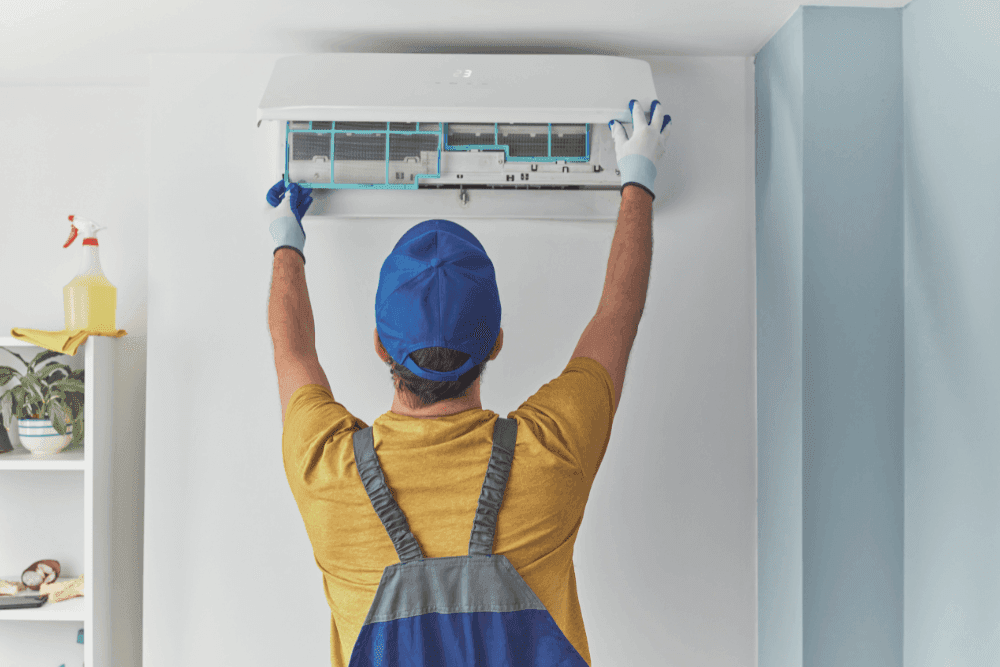
A bad smell from your AC isn't one problem — it's several different problems that happen to share a symptom. Musty and moldy is by far the most common, but sewage-like, chemical-sweet, and burning smells each point somewhere completely different, and treating one like another wastes time at best and misses something genuinely urgent at worst. This guide starts by helping you tell them apart, then covers the six real causes of a musty AC smell specifically, what's safe to clean yourself, and when it's actually a health or habitability issue rather than just an annoyance.
Identify your smell first — they're not the same problem
Most people searching for a musty AC smell do have a musty AC smell, and the rest of this guide is for you. But a meaningful minority are describing something else and reaching for the wrong search term, so it's worth ten seconds to check before assuming.
| What it smells like | Likely cause | What to do |
|---|---|---|
| Damp, earthy, wet cardboard, old socks | Mold or mildew on the coil, drain pan, or ducts — this guide | Continue below |
| Sewage, rotten egg, drain smell | A dried-out drain trap nearby, or organic buildup in the condensate line itself | Check the drain line; if it persists, treat as a drainage fault |
| Sweet, chemical, slightly like nail polish or ether | A refrigerant leak — the smell of escaping gas, not something growing | Stop using the unit and book a technician; not a cleaning issue |
| Burning, electrical, hot plastic | Overheating wiring, a failing motor, or dust burning on a genuinely hot component | Switch off at the breaker immediately — don't run it to see if it stops |
| Sharp, sudden, localized to one vent, doesn't fade | A dead pest inside the ductwork or unit | Book an inspection; not something cleaning sprays fix |
Damp, earthy, wet cardboard, old socks
- Likely cause
- Mold or mildew on the coil, drain pan, or ducts — this guide
- What to do
- Continue below
Sewage, rotten egg, drain smell
- Likely cause
- A dried-out drain trap nearby, or organic buildup in the condensate line itself
- What to do
- Check the drain line; if it persists, treat as a drainage fault
Sweet, chemical, slightly like nail polish or ether
- Likely cause
- A refrigerant leak — the smell of escaping gas, not something growing
- What to do
- Stop using the unit and book a technician; not a cleaning issue
Burning, electrical, hot plastic
- Likely cause
- Overheating wiring, a failing motor, or dust burning on a genuinely hot component
- What to do
- Switch off at the breaker immediately — don't run it to see if it stops
Sharp, sudden, localized to one vent, doesn't fade
- Likely cause
- A dead pest inside the ductwork or unit
- What to do
- Book an inspection; not something cleaning sprays fix
If yours is burning or electrical, stop reading this guide and switch the unit off at the breaker — that's a different, more urgent problem covered on our AC Repair page, not something a cleaning treatment addresses. If it's chemical-sweet, the same applies: that's refrigerant escaping under pressure, and no amount of coil or duct cleaning touches it. Everything from here on is about the musty, damp, mold-type smell — the one behind the large majority of searches for this.
The 6 real causes of a musty AC smell
1. Mold or mildew on the evaporator coil
The evaporator coil is cold, damp for most of every cooling cycle, and sitting in the dark inside the indoor unit — three of the four conditions mold needs to establish itself, missing only a food source, which airborne dust supplies constantly. Once a thin biofilm builds up on the coil's fins, it holds moisture longer than a clean coil would and produces exactly the damp, stale smell this guide is about — often strongest in the first minute or two after the AC starts, as air first passes over the contaminated surface before it's had time to disperse through the room.
This is the single most common cause of a genuinely musty smell, and it's also one you can't fix yourself — the coil sits inside the sealed indoor unit casing, and improvised cleaning (a spray bottle through the front grille, for instance) typically reaches only the visible edge of the coil while leaving the contaminated interior untouched, sometimes pushing moisture further in instead.
2. A dirty or standing-water drain pan
The drain pan collects the water dripping off the coil before it leaves through the condensate line. Dust and organic residue settle in it the same way they settle everywhere else in the unit, and if drainage is even slightly slow, a shallow layer of standing water sits in the pan between cooling cycles rather than draining away completely — exactly the stagnant, warm, dark conditions bacteria and mold need. This is often the source when the smell has a slightly different character than pure mustiness — closer to stale or stagnant water than damp cardboard — and it's especially easy to miss on ceiling-concealed units where the pan isn't visible without opening the access panel.
3. A slow or partially blocked condensate drain
A drain line doesn't need to be fully blocked to cause a smell — a partial restriction is enough to let water sit in the line and the pan longer than it should, giving mold and bacteria time to establish themselves even while the system is still technically draining and showing no visible leak yet. If you're also seeing any dripping, water marks near the ceiling, or the smell returning within days of a cleaning visit, the drain line itself is the more likely root cause rather than the coil — see our AC Leaking Water guide for the full diagnostic if there's any dripping alongside the smell, since the two problems frequently share this one cause.
4. Dust and organic buildup inside the ductwork
On ducted and central systems, and in any property with a fresh-air intake, dust and debris accumulate inside the duct runs themselves — not just at the indoor unit. If the smell comes from more than one room or vent rather than concentrating at a single indoor unit, and it doesn't fade after a filter change, the ducts themselves are a more likely source than the coil. Moisture intrusion into a duct run — from a leak elsewhere, condensation on a poorly insulated section, or simple humidity — turns ordinary dust buildup into the same mold-friendly conditions found on a dirty coil, just spread across a much larger surface area that's harder to inspect.
Villas with a dedicated fresh-air intake — common across Abu Dhabi's larger properties — add a specific version of this: outdoor air, dust, and humidity enter the duct system directly rather than only recirculating filtered indoor air, giving that intake section more raw material to accumulate than a purely recirculating system sees. If your property has one and the smell is strongest near a fresh-air supply vent specifically rather than spread evenly, that intake path — and its own filter, which is separate from the main unit's filter and easy to forget — is worth checking first.
5. A dirty or damp air filter
A filter loaded with dust holds moisture the same way anything else covered in fine particulate does, and a washable filter reinstalled before it's fully dry introduces dampness directly into the airflow path every time the AC starts. This is the most common cause of a smell that's mild, present only briefly at startup, and resolves on its own once the unit's been running a few minutes — a genuinely different pattern from the stronger, more persistent smell a contaminated coil or standing water in the pan produces. It's also, again, the easiest thing on this list to check yourself.
6. Standing water or moisture near the unit, unrelated to the AC's own drainage
Sometimes the AC isn't the actual source — it's just distributing a smell that's coming from somewhere nearby. A slow leak elsewhere in the ceiling void, a poorly sealed roof penetration near a rooftop condenser, or general dampness in a service area the return air passes through can all produce a musty smell that seems to come from the AC because that's where the air carrying it enters the room. The tell here is a smell that's present even when the AC has been off for a while — a coil or drain-pan smell fades over hours without the unit running; a smell from an external moisture source doesn't.
Why mold establishes itself inside an AC specifically
Mold needs four things to grow: a food source, moisture, warmth, and darkness. A working AC's indoor unit supplies three of those constantly — the coil sits in the dark inside the casing, runs at a temperature comfortably within mold's preferred range, and stays damp with condensation for most of every cooling cycle. The fourth, food, is dust: organic particulate that settles on the coil, in the drain pan, and along duct surfaces provides exactly what mold spores need to establish a colony once they land on a damp surface, which they do constantly since mold spores are present in ordinary indoor and outdoor air everywhere, not just in already-affected units.
This is why a clean, well-maintained AC in the same room as a poorly maintained one can smell completely different despite running in identical conditions — the difference isn't the air coming into either unit, it's how much dust and standing moisture each one is giving mold to work with. It's also why spraying a fragrance or disinfectant into the vents doesn't solve anything: it doesn't remove the food source or the moisture, so the colony producing the smell is still there and still growing, just temporarily masked.
Diagnose your smell in 60 seconds
Before booking anyone, this narrows down which of the six causes above is most likely, the same way the pattern-matching table earlier in this guide narrows down which type of smell you actually have.
| Pattern | Most likely cause | Next step |
|---|---|---|
| Strong at startup, fades within a few minutes | Dirty or damp filter | Clean or replace the filter first |
| Constant the entire time the AC runs, no dripping | Contaminated coil | Book coil cleaning |
| Constant, plus occasional dripping or damp patches | Standing water in the drain pan or a slow drain line | Book drain and pan service; check the leak guide if dripping is visible |
| Present from several rooms or vents evenly | Duct contamination | Book duct cleaning, ideally after an inspection confirms it |
| Present even when the AC has been off for hours | External moisture source, not the AC's own drainage | Investigate nearby damp areas, ceiling voids, or roof penetrations |
| Returned within days of a previous cleaning | Drain line still partially restricted | Ask for drain-specific service, not a repeat of the same coil clean |
Strong at startup, fades within a few minutes
- Most likely cause
- Dirty or damp filter
- Next step
- Clean or replace the filter first
Constant the entire time the AC runs, no dripping
- Most likely cause
- Contaminated coil
- Next step
- Book coil cleaning
Constant, plus occasional dripping or damp patches
- Most likely cause
- Standing water in the drain pan or a slow drain line
- Next step
- Book drain and pan service; check the leak guide if dripping is visible
Present from several rooms or vents evenly
- Most likely cause
- Duct contamination
- Next step
- Book duct cleaning, ideally after an inspection confirms it
Present even when the AC has been off for hours
- Most likely cause
- External moisture source, not the AC's own drainage
- Next step
- Investigate nearby damp areas, ceiling voids, or roof penetrations
Returned within days of a previous cleaning
- Most likely cause
- Drain line still partially restricted
- Next step
- Ask for drain-specific service, not a repeat of the same coil clean
Nearly every cause above depends on the same two ingredients — moisture and dust — and Abu Dhabi supplies both in larger quantities, for more of the year, than the climates most generic AC advice is written for. Units here run for the better part of the year rather than a few summer months, giving mold on a contaminated coil far more continuous, undisturbed time to establish itself than seasonal on-off operation would allow elsewhere. Airborne dust and fine sand settle into filters and onto coils faster too, shortening the interval between a clean system and a genuinely contaminated one.
Building type changes where the smell tends to concentrate. In Abu Dhabi's sealed, centrally-cooled apartment towers — Al Reem Island, the Corniche, and similar developments — a concealed fan coil unit above a false ceiling has limited natural airflow around it even when it's off, which slows drying between cycles and gives standing water in the pan more time to turn stagnant. In villa communities like Khalifa City, Al Shamkha, and Mohamed Bin Zayed City, outdoor-facing ductwork exposed to direct heat and dust can accumulate buildup faster on the duct-contamination path (cause 4) than an equivalent indoor-only run would. Worth mentioning your building type and whether it's a concealed or wall-mounted unit when you book — it changes which cause is checked first.
Is a musty AC smell actually dangerous?
A straight answer, without either dismissing it or overstating it: mold and mildew growing inside an AC system is a genuine air quality issue, not just an unpleasant smell to mask. Mold spores circulated through a home's air are a well-established irritant for people with asthma, allergies, or general respiratory sensitivity, and prolonged exposure in a sealed, air-conditioned space — which describes most Abu Dhabi homes for most of the year — means more consistent exposure than an equivalent issue somewhere with more natural ventilation.
That said, a musty smell on its own isn't a medical emergency, and there's no need to evacuate a room or panic over it. It's a genuine reason to have the actual source cleaned rather than masked, particularly if anyone in the home has existing respiratory sensitivity — but the appropriate response is booking a proper coil, drain, or duct clean, not assuming the worst about air quality from smell alone.
Worth separating from the headline-grabbing "toxic black mold" stories: the mold typically found on an AC coil or in a drain pan is common environmental mold, the same broad category found in damp bathrooms or on neglected fridge seals, not the rarer toxin-producing species those stories are usually about. It's still worth removing properly rather than living with, but it's not the emergency the term "toxic mold" implies for the ordinary case of a musty-smelling AC.
What's safe to clean yourself
- Clean or replace the filter. Slide it out, wash a reusable one with plain water, and let it dry completely before reinstalling — a damp filter put back too soon causes exactly the smell you're trying to fix.
- Wipe the accessible grilles. The supply and return grilles on the visible front of the indoor unit can be wiped with a clean, slightly damp cloth to remove surface dust.
- Check for anything obviously damp nearby. Look around the indoor unit and any accessible ceiling panel for water marks, damp patches, or anything that smells stronger up close than the general room air does.
- Note the pattern. Strongest at startup and fading after a few minutes points toward the filter. Constant regardless of whether the AC is running points toward an external moisture source. Strongest from a specific vent or room points toward that zone's ductwork or unit specifically.
- Keep the area around the return grille clear. Furniture, curtains, or stored items blocking a return vent restrict airflow the same way a dirty filter does, and can trap moisture in the surrounding area.
What not to do: don't spray air freshener, perfume, bleach, or disinfectant into the vents or grilles. This masks the smell without touching whatever's actually producing it, and certain chemicals can damage coil coatings, filter material, or plastic housing over repeated use — meaning you've spent money and potentially caused a second problem without solving the first.
When it needs a professional — and which service actually fixes it
This is where a musty smell trips people up: coil cleaning, duct cleaning, and drain-line service are three different jobs that fix three different causes, and booking the wrong one means paying for a clean, tidy system that still smells the same afterward.
| If the pattern points to... | The service that actually fixes it | Why |
|---|---|---|
| Mold or contamination on the coil itself (cause 1) | Coil cleaning | Reaches the actual coil surface, not just the visible grille |
| Standing water or residue in the drain pan (cause 2) | Drain pan and coil cleaning together | Pan and coil sit right next to each other and are usually serviced in one visit |
| Slow drainage, any dripping alongside the smell (cause 3) | Drain line service | Clears the actual restriction rather than treating a symptom of it |
| Smell from multiple rooms or vents, not one unit (cause 4) | Duct cleaning | Addresses buildup along the duct run itself, which coil cleaning doesn't reach |
| Mild smell, fades after a few minutes of running | Filter replacement — try this first | Often resolves it without needing any of the above |
Mold or contamination on the coil itself (cause 1)
- The service that actually fixes it
- Coil cleaning
- Why
- Reaches the actual coil surface, not just the visible grille
Standing water or residue in the drain pan (cause 2)
- The service that actually fixes it
- Drain pan and coil cleaning together
- Why
- Pan and coil sit right next to each other and are usually serviced in one visit
Slow drainage, any dripping alongside the smell (cause 3)
- The service that actually fixes it
- Drain line service
- Why
- Clears the actual restriction rather than treating a symptom of it
Smell from multiple rooms or vents, not one unit (cause 4)
- The service that actually fixes it
- Duct cleaning
- Why
- Addresses buildup along the duct run itself, which coil cleaning doesn't reach
Mild smell, fades after a few minutes of running
- The service that actually fixes it
- Filter replacement — try this first
- Why
- Often resolves it without needing any of the above
If you're not sure which applies, a full inspection before booking a specific service is worth the short delay — it's cheaper than paying for duct cleaning when the actual problem was the coil, or vice versa.
If you rent: is this the landlord's problem?
Same general framework as any other AC fault under Abu Dhabi's Tenancy Law (Law No. 20 of 2006): landlords are generally responsible for necessary repairs and keeping the property fit for use, which reasonably extends to mold growing inside a fixed AC system rather than something caused by tenant misuse. A persistent musty smell — particularly one with a genuine air-quality angle for a household member with respiratory sensitivity — is a fair habitability concern to raise directly with a landlord or building management before assuming it's something you're expected to just live with or fix at your own cost.
Check your tenancy contract first, since it can set responsibility differently from the law's default, and keep any inspection or cleaning report as documentation if a dispute becomes necessary — Abu Dhabi's Rent Dispute Settlement Committee is the formal route for anything that can't be resolved directly, though for a cleaning-scale issue like this, getting it fixed and sorting out payment after is usually the faster path for everyone.
What it costs to fix in Abu Dhabi
| Service | Typical cost | Notes |
|---|---|---|
| Filter clean or replace | AED 50 – 150 | Try this first if the smell is mild and fades quickly |
| Evaporator coil cleaning | AED 250 – 500 | The most common fix for a genuinely musty smell |
| Drain pan and coil cleaning (combined) | AED 300 – 600 | Common when both show contamination |
| Drain line flush | AED 150 – 300 | When the smell comes with any dripping or slow drainage |
| Duct cleaning (per system) | AED 400 – 900 | Scope and price depend on duct length and number of vents |
| UV-C or antimicrobial coil treatment (add-on) | AED 150 – 350 | Optional, slows regrowth between services — not a substitute for the clean itself |
Filter clean or replace
- Typical cost
- AED 50 – 150
- Notes
- Try this first if the smell is mild and fades quickly
Evaporator coil cleaning
- Typical cost
- AED 250 – 500
- Notes
- The most common fix for a genuinely musty smell
Drain pan and coil cleaning (combined)
- Typical cost
- AED 300 – 600
- Notes
- Common when both show contamination
Drain line flush
- Typical cost
- AED 150 – 300
- Notes
- When the smell comes with any dripping or slow drainage
Duct cleaning (per system)
- Typical cost
- AED 400 – 900
- Notes
- Scope and price depend on duct length and number of vents
UV-C or antimicrobial coil treatment (add-on)
- Typical cost
- AED 150 – 350
- Notes
- Optional, slows regrowth between services — not a substitute for the clean itself
On the UV-C question specifically: it's a genuine, reasonable add-on for a property that's had recurring smell problems, since it slows how quickly mold re-establishes on a freshly cleaned coil — but it's an addition to a proper clean, not a replacement for one. Booking UV-C treatment on a coil that's never actually been cleaned treats the wrong problem.
Keeping it from coming back
The two habits that prevent most recurrence: filters cleaned or replaced monthly through peak summer rather than on a generic multi-month schedule, and an annual service that includes coil and drain pan cleaning as standard rather than only when a smell has already developed. Both are covered under an AC Maintenance / AMC contract if you'd rather have it scheduled than track it yourself — and if you're dealing with both a smell and any visible dripping, our AC Leaking Water guide covers the drainage side in full, since the two issues share several of the same root causes.